Sweden is where the North slows its breathing. Fewer hairpins, more horizon, and a different kind of discipline.
The Feel of the E45
The E45 enters Sweden at Gothenburg and runs roughly 1,700 kilometres to Karesuando on the Finnish border, and its inland section, Inlandsvägen, is the spine of northern Sweden. North of Mora the towns thin out: Sveg, Östersund on the great lake Storsjön, Strömsund, Vilhelmina, Storuman, Sorsele, Arvidsjaur, Jokkmokk, Gällivare. Between them lie long stretches of forest, bog, lake and river, with the old Inlandsbanan railway never far away.
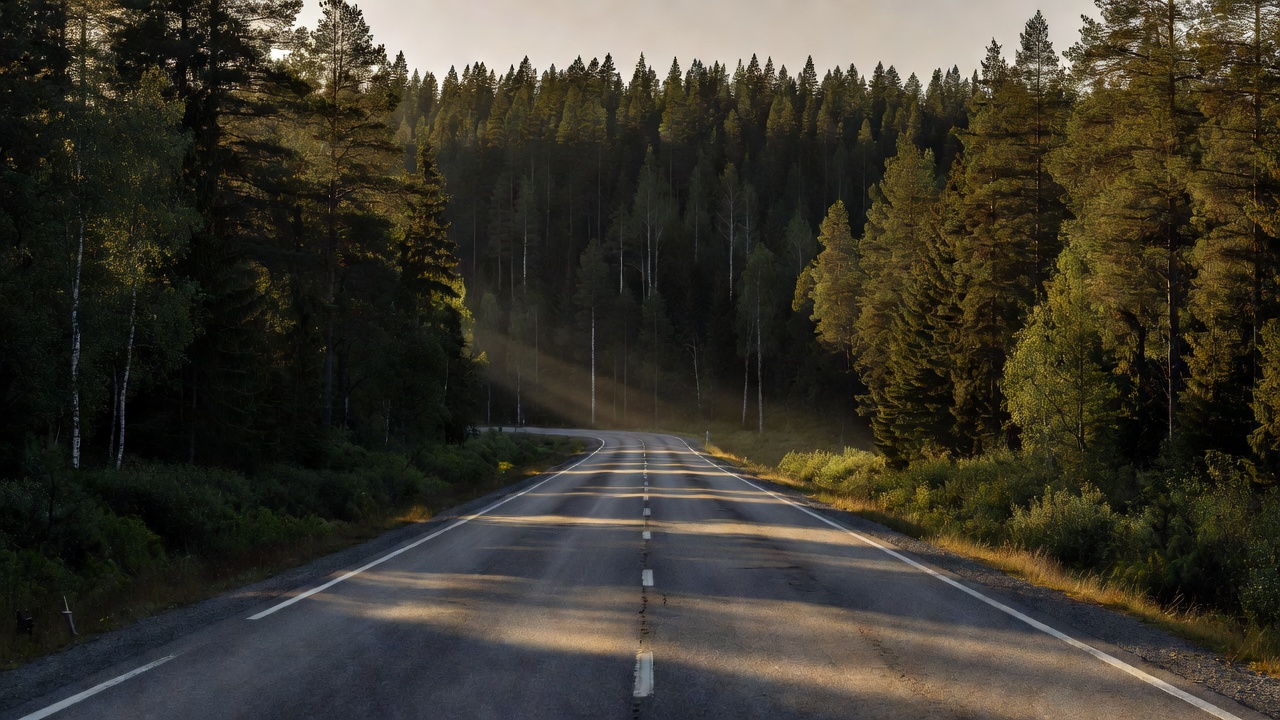
If Norway is a road of corners, the E45 is a road of rhythm. The surface is generally good, curves are sweeping, and the traffic thins until you can ride for an hour and meet a handful of vehicles. The challenge is mental. It is easy to drift above the limit on empty roads, and Swedish speed cameras are common. It is easy to lose concentration, and that is exactly when a moose or a herd of reindeer steps out of the trees.
The E45 does not test your cornering. It tests your attention, mile after quiet mile.
North of Arvidsjaur. The light at this hour is beautiful and exactly when wildlife moves.
Crossing Into the Arctic
South of Jokkmokk the E45 crosses the Arctic Circle, marked by a roadside sign where most riders stop for the photo. Jokkmokk is a centre of Sámi culture, home to the Ájtte Swedish Mountain and Sámi Museum, and its winter market held each February has run for more than four centuries. In summer the town is quiet, but the museum is a valuable stop to understand the reindeer-herding landscape you are riding through.
Reindeer are semi-domesticated and roam freely here. They often stand on the road, and they do not hurry. Slow right down, give them space and never try to ride through a group. Moose are the greater danger: large, dark and most active at dawn and dusk, which in summer can mean the long hours of evening light. Warning signs are there for a reason.
Fuel stations in the far north are often unmanned and card-operated, and the gaps between them can exceed the range of a small-tank bike. Fill up whenever you pass a station north of Östersund, and carry a card with a chip and PIN.
Swedish Routes at a Glance
1,700 km
E45 Inlandsvägen
Gothenburg to Karesuando, the inland route north. Pick the northern half for the real wilderness.
E12
Blue Highway
From Umeå through Storuman and over the mountains to Mo i Rana in Norway. A natural link west.
E10
Kiruna to Narvik
Over the border at Riksgränsen, through bare mountains, down to the Norwegian coast and on to Lofoten.
UNESCO
High Coast
Höga Kusten on the Gulf of Bothnia. Short, hilly backroads and the High Coast Bridge.
The High Coast: Short Roads, Steep Hills
Höga Kusten, on the Gulf of Bothnia between Härnösand and Örnsköldsvik, was inscribed as a UNESCO World Heritage Site in 2000 for its land uplift. Since the last ice age the land here has risen around 286 metres, the highest known postglacial rebound in the world, leaving raised beaches and old shorelines high on the hillsides.
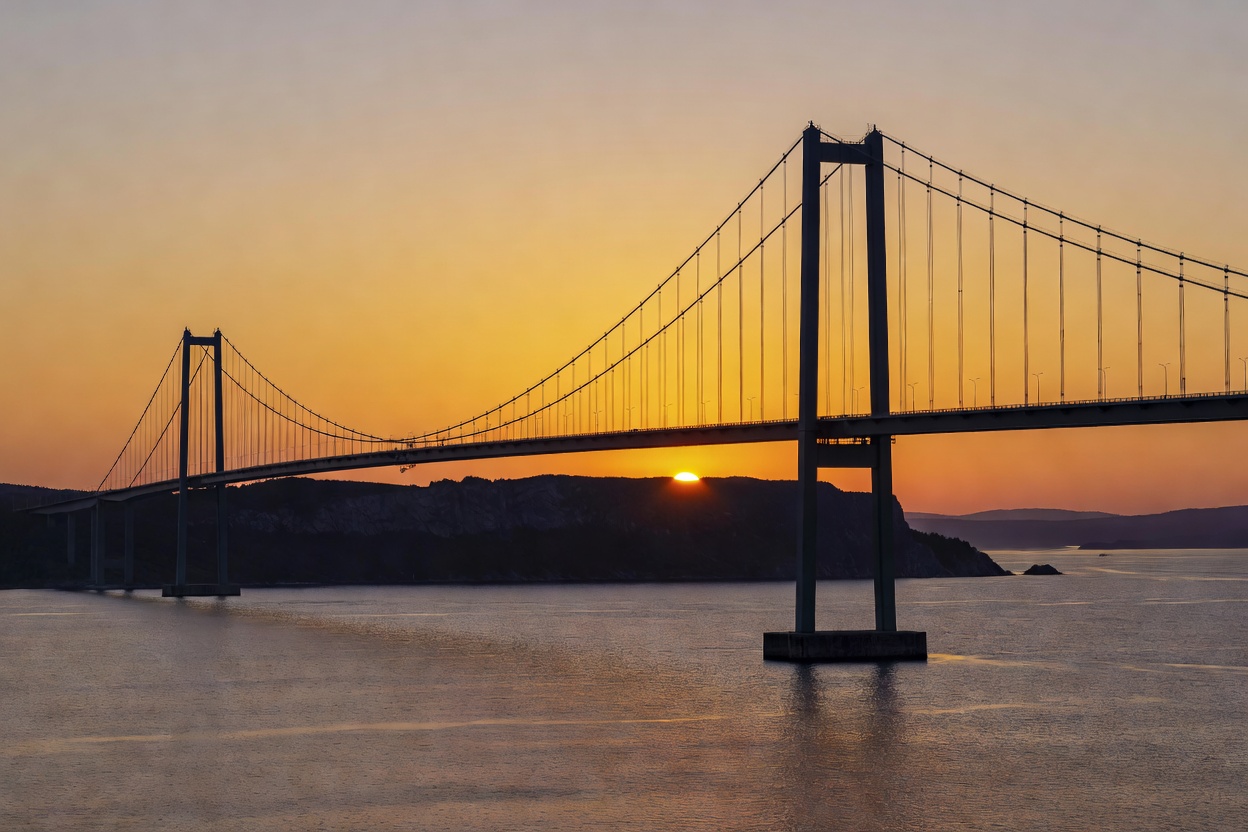
For a rider, that geology means something unusual for the Swedish coast: hills. The E4 crosses the Ångermanälven estuary on the High Coast Bridge, opened in 1997 and one of the longest suspension bridges in Scandinavia. Leave the E4 as soon as you can. The minor roads around Nordingrå roll and twist between fishing villages, red cottages and forest, and the steep mountain of Skuleberget rises beside the road further north. It is a slow, rewarding day rather than a long one.
Combining Sweden and Norway
A popular loop runs north on the E45, crosses to Norway on the E10 from Kiruna to Narvik, rides Lofoten west to the Moskenes ferry, and returns south along the Norwegian coast. Another heads west on the E12 Blue Highway to Mo i Rana. Either way, Sweden becomes the calm approach and Norway the dramatic finale.