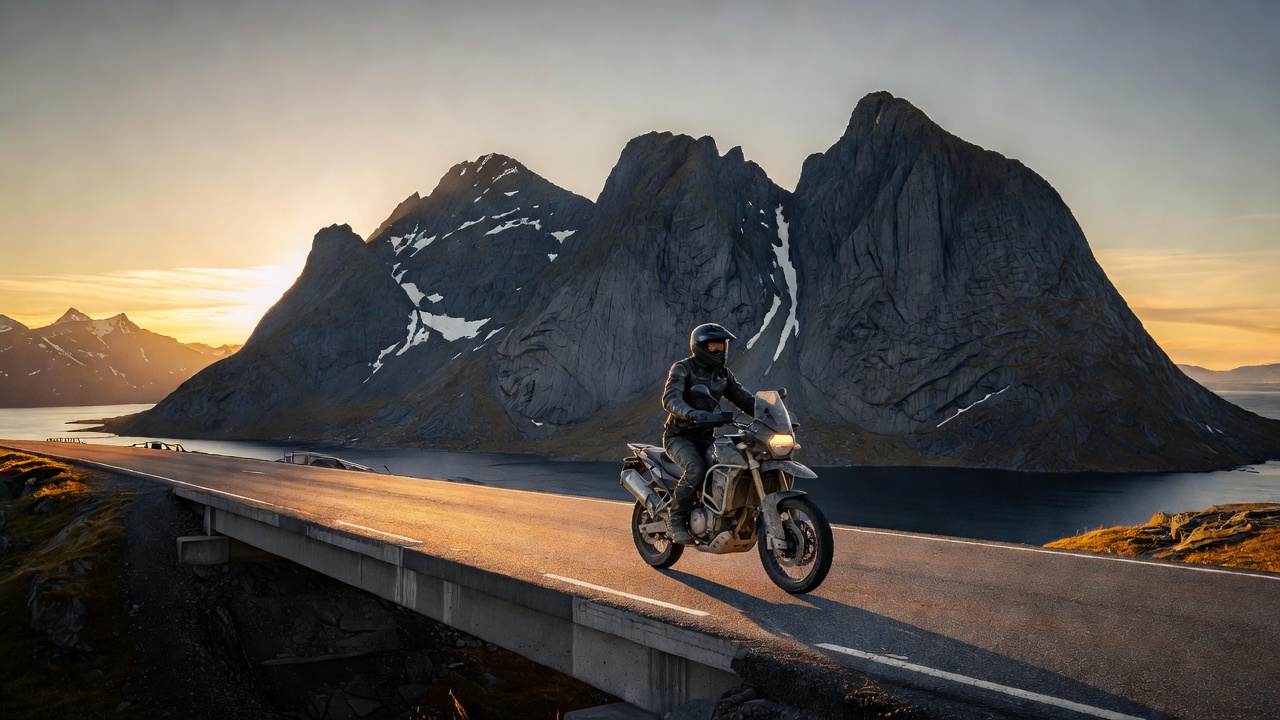
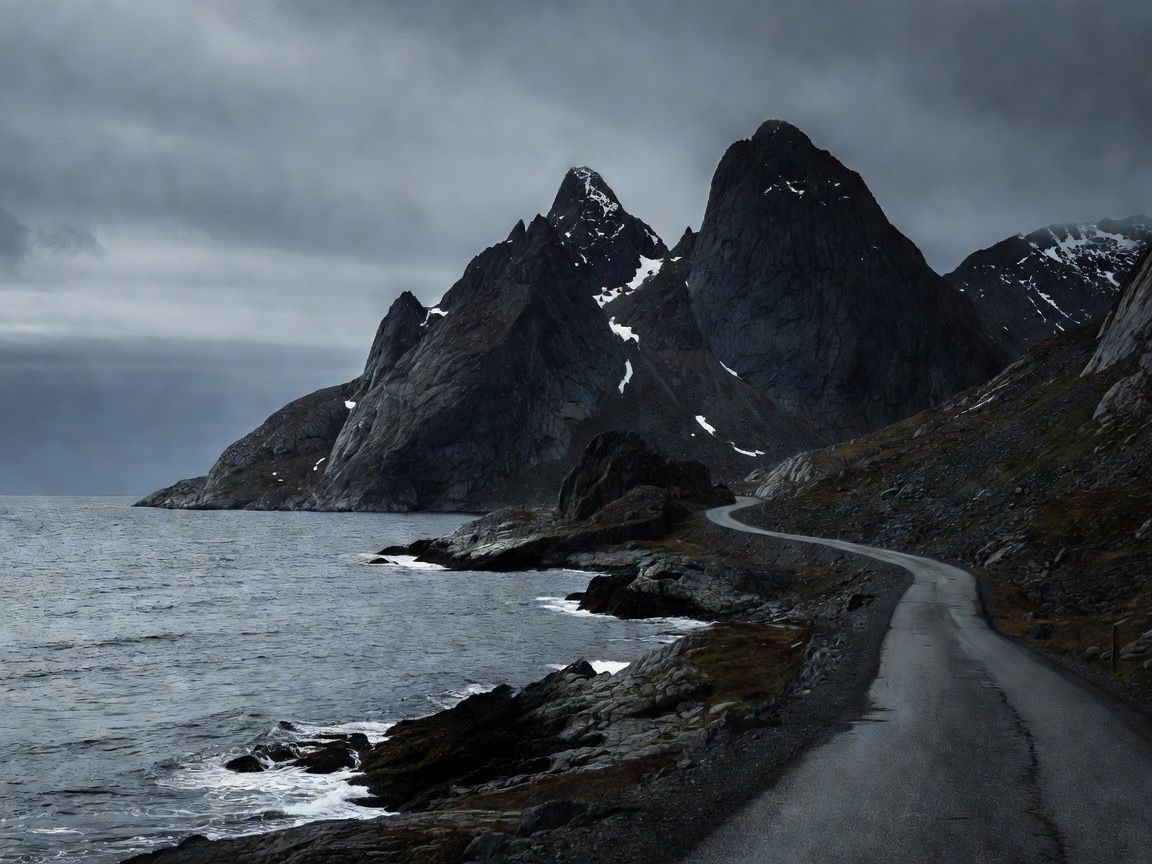
Above the Arctic Circle the mountains rise straight out of the sea, the sun barely sets in early summer and the wind decides how your day goes.
Getting There Is Half the Ride
There are two ways onto Lofoten with a motorcycle, and they suit different riders. The first is the ferry from Bodø to Moskenes, a crossing of the open Vestfjorden that takes around three to three and a half hours. It lands you at the western end of the archipelago, close to Reine and Å, and it can be rough. In high summer it is also the bottleneck of the whole trip: book well ahead, and expect queues if you have not.
The second is by road. Since 2007 the Lofast connection has linked the islands to the mainland along the E10 from the Bjerkvik and Narvik area, with tunnels and bridges replacing what used to be a ferry. It is a fine ride in its own right, through Vesterålen landscapes, and it means you can enter Lofoten from the east and leave by ferry from Moskenes, seeing everything once without backtracking.
Riders coming from Sweden often take the E10 west from Kiruna, crossing the border at Riksgränsen and dropping to Narvik through a barren, high landscape that is a highlight before you have even reached the coast.
The E10 west of Hamnøy. Bridges like this are where crosswinds bite hardest.
Riding the E10 West to Å
The Lofoten stretch of the E10 is known as King Olav's Road, and it runs from the eastern islands through Svolvær, the main town, past Leknes and Ramberg to the fishing village of Å, where the road simply ends. It is part of the Lofoten National Tourist Route. The riding itself is rarely demanding: the road is two lanes, mostly well surfaced, and the curves are gentle. What makes it remarkable is the scenery, which escalates the further west you go.
Take the side road to Henningsvær, a fishing village built across small islands and linked by bridges, and allow time around Hamnøy and Reine, where red fishermen's cabins sit beneath granite walls. The Fredvang bridges north of Flakstad lead to a quieter road worth a detour. Tunnels such as the subsea Nappstraumen tunnel are cold and damp; keep a layer ready.
On Lofoten the road is easy. The wind, the sheep and the parked campervans are not.
The trade-offs: July traffic is heavy, parking at viewpoints is limited and many drivers are looking at the mountains instead of the road. Sheep wander freely. Wind across the bridges can shove a loaded bike sideways, and rain can last for days. When it clears, though, the light at midnight is golden and you will understand why riders come back.
Arctic Routes at a Glance
230 km
Lofoten National Tourist Route
The E10 through the islands to Å. Gentle curves, heavy summer traffic, superb light.
102 km
Senja National Tourist Route
Coast roads from Gryllefjord to Botnhamn via Bergsbotn and Tungeneset. Narrow, tunnelled, quieter.
3–3.5 h
Bodø–Moskenes
Open-sea ferry across Vestfjorden. Book ahead in summer and strap the bike well.
2007
Lofast
The road link to the mainland on the E10, ending the need for a ferry from the east.
Senja: Lofoten Without the Crowds
Norway's second-largest island lies further north, between Lofoten and Tromsø, and riders who have done both often prefer it. The Senja National Tourist Route follows the outer coast between Gryllefjord and Botnhamn, passing the Bergsbotn viewing platform over Bergsfjord, the Tungeneset rocks with their saw-tooth ridge of peaks known as the Devil's Teeth, and the sheltered beach at Ersfjord.
The roads here are narrower than the E10, with short tunnels, single-lane sections and steep pitches between fjords. Traffic is lighter, services are fewer and fuel stops are worth planning. In summer, the ferry between Gryllefjord and Andenes across the Andfjorden links Senja with Andøya and Vesterålen, making a natural chain with Lofoten. At the northern end, the ferry from Botnhamn to Brensholmen connects towards Kvaløya and Tromsø.
Riding Under the Midnight Sun
In Lofoten the sun stays above the horizon from roughly late May to mid-July. It is tempting to ride at midnight, and the light is extraordinary, but fatigue builds quickly when your body never gets a signal to stop. Set yourself a hard limit on riding hours and pack an eye mask for sleeping.